




A technical guide to the skimming plasters stocked by Pelican Systems, with application tips for a smooth, paint-ready surface.
Skimming plasters are the thin finishing coat that turns a rough wall or ceiling into a smooth, paint-ready surface. A skim coat is applied over brickwork, concrete, cement plaster, or plasterboard to level out minor imperfections and leave a fine, uniform finish ready for decoration. For contractors and architects, the skimming plaster you specify sets the quality of the final surface. A good skim gives a flat, hard-wearing base that takes paint cleanly, while a poor choice shows up as trowel marks, hollows, or cracking once the paint goes on.
This guide sets out a factual comparison of the skimming plasters stocked by Pelican Systems: JUMBO Skimming, Casofour Handskim, OMV Metacote and Gyproc RhinoLite Multipurpose. It covers the technical specifications of each, a side by side comparison table, and a set of trade tips for achieving a flawless plaster finish on site.

Why the right skimming plaster matters
A skimming plaster has to do two things well: it must spread smoothly under the trowel, and it must set and dry to a hard, stable surface that will not move under paint. Working time, setting time, and drying time all change with temperature, humidity, and the substrate. Coastal sites with high humidity often need a plaster with a longer working window, while fast setting product suits dry inland conditions and teams that want to finish in a single pass. Matching the plaster to the substrate, the climate and the pace of the team is the first step to a flawless finish. All of the products below are gypsum based and formulated for interior use only, and all installations should follow SABISA guidelines.
Product Brands
JUMBO Skimming Plaster, by Pelican Systems
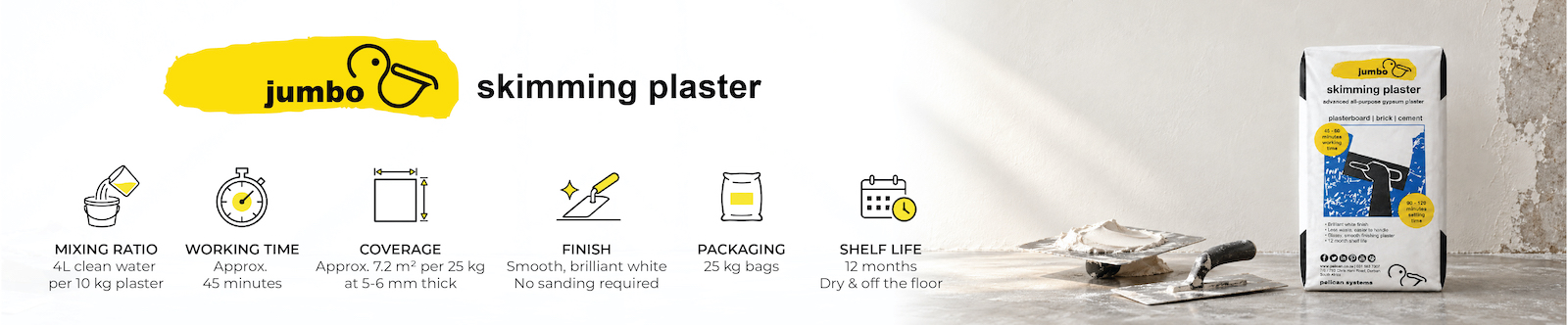
JUMBO Skimming Plaster is the Pelican Systems own brand skim coat, a multipurpose interior gypsum plaster formulated for skimming brick, plasterboard, and cement with no need for pre-treatment. It is a one-step product that builds a smooth, inert, high quality surface on internal walls and ceilings and a durable base for decorative finishes. The JUMBO range is designed to be chip and crack resistant, with a smooth, white finish.
The main working figures are:
- Mixing ratio: 4 litres of clean water per kilogram, roughly 4 litres per 10 kilograms, at a water addition rate of about 32 percent. Sprinkle the powder into clean cold water, wait for it to soak, then mix to a smooth, lump free, creamy slurry.
- Working time: about 45 minutes. Do not mix more than you can use in 45 minutes, and do not re-stir or add powder or water once the mix is complete.
- Coverage: approximately 7.2 square metres per 25 kilogram bag at 5 to 6 millimetres thick, or about 3.6 square metres at 12 to 13 millimetres, which works out at roughly 0.289 square metres per kilogram.
- Finish: silky smooth and brilliant white, hard once dry so it resists chipping, cracking, and shrinkage, and smooth enough that it needs no sanding before painting.
- Packaging: 25 kilogram bags.
- Shelf life: 12 months when stored correctly, dry and off the floor.
Use clean water, a clean container and clean tools free of previously set material, as residue shortens the setting time. Do not apply the plaster in below freezing temperatures, and use water that is close to neutral pH, since excess alum, chloride or sulphate can make the plaster set too quickly.

Casofour Handskim, identified by their blue and yellow packaging
Casofour Handskim is a locally manufactured multipurpose skim plaster for interior finishing of cement plaster, drywall, ceilings, and cement blocks. It comes in two formulations tuned to different conditions and trowel techniques. Handskim Blue is formulated for inland plasterers and is made from a combination of synthetic and natural gypsum with nominal additives. Handskim Yellow is formulated for coastal plasterers and also includes natural gypsum.
The main working figures are:
- Composition: calcium sulphate hemihydrate, natural gypsum, silica, an accelerant, and a retarder.
- Water to plaster ratio: 0 to 6.6 litres of clean water per 10 kilograms for Blue, and 5.5 to 6.2 litres per 10 kilograms for Yellow.
- Workability: approximately 30 minutes for Blue and approximately 55 minutes for Yellow, giving the coastal formulation a longer working window.
- Final setting time: approximately 65 minutes for Blue and approximately 90 minutes for Yellow.
- pH: 5 to 7.5 for Blue and above 9 for Yellow.
- Coverage: > 25 square metres per 40 kilogram bag at 3 millimetres.
- Packaging: 40 kilogram bags, with a 20 kilogram option.
- Shelf Life: 6 months – stored in dry conditions and covered.
Apply the mixed plaster at about 3 millimetres with a trowel. Around 40 to 60 minutes after application, splash a little water onto the surface with a block brush and float it. This brings the fine material, known as the fat, to the surface. Polish off the excess fat with water to leave a glass-like finish.
OMV Metacote, Inland and Coastal
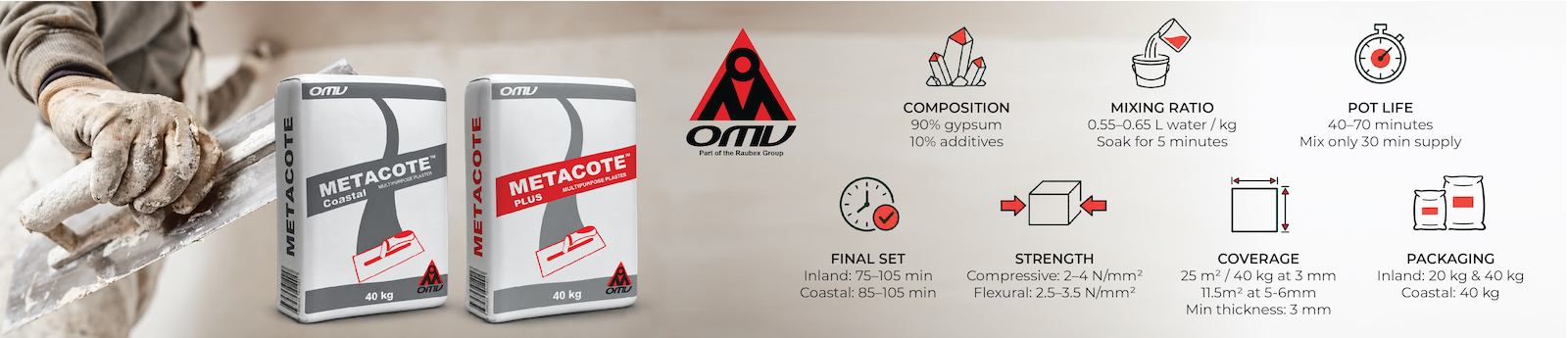
Metacote, made by OMV (Pty) Ltd, is a formulated and retarded gypsum hemihydrate finishing plaster. It works as a combined base coat and finishing plaster for internal brickwork, concrete blocks, drywalling, and ceilings, and as a finishing plaster over sand cement base coats. It complies with DIN EN 13279-1 and is graded Category C6, the same standard the Metacote and Metajoint plaster products meet. Metacote comes in an Inland and Coastal grade tuned for different setting conditions.
The main working figures from the technical data sheets are:
- Composition: about 90 percent calcium sulphate hemihydrate with 10 percent additives. Off-white, 85 to 95 percent on the whiteness scale, with a pH of 7 to 10.
- Mixing ratio: 55 to 0.65 litres of water per kilogram. Add 40 kilograms to 22 to 26 litres of water and soak for 5 minutes before mixing to a smooth paste.
- Pot life: 40 to 70 minutes. Do not mix more than you can use in 30 minutes.
- Setting time: final set 75 to 105 minutes for Inland and 85 to 105 minutes for Coastal, with a typical drying time on board of 24 to 48 hours.
- Strength: compressive strength 2 to 4 newtons per square millimetre and flexural strength 2.5 to 3.5 newtons per square millimetre, both to DIN EN 13279-2.
- Coverage: 25 square metres per 40 kilogram bag at 3 millimetres, or 11.5 square metres at 5 to 6 millimetres. Do not apply less than 3 millimetres thick.
- Packaging: 40 and 20 kilogram bags for Inland, and 40 kilogram bags for Coastal.
Apply to a clean surface and sprinkle the surface with water first. Level with a steel float at 20 to 30 minutes, wet float at 45 to 55 minutes, then complete the final finishing by scraping to a smooth surface with a steel float at 60 to 70 minutes.
RhinoLite Multipurpose Plaster, by Gyproc Saint-Gobain
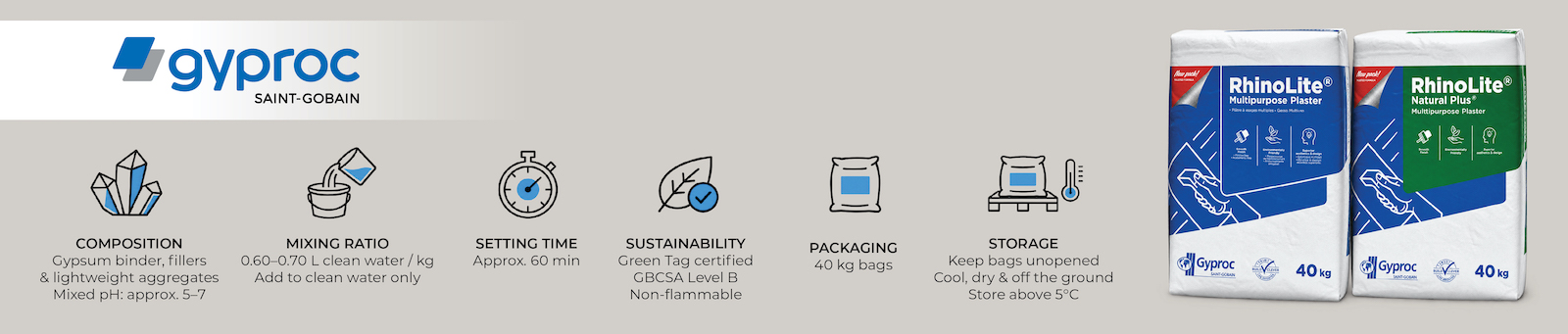
RhinoLite Multipurpose Plaster is Gyproc’s lightweight multipurpose finishing plaster for interior application onto brickwork, concrete block, concrete, and Rhino Board, and as a finishing plaster over sand cement base coats. It is applied as a one-coat product with a steel trowel and a rubber float.
The main working figures are:
- Composition: calcium sulphate hemihydrate, fillers, lightweight aggregates and other minor ingredients, the minor ingredients at less than 1 percent. Grey to white powder, pH about 5 to 7 once mixed.
- Mixing ratio: 60 to 0.70 litres of clean water per kilogram. Use neat and add to clean water only, mixing to the consistency that suits the application.
- Setting time: approximately 60 minutes.
- Sustainability: Green Tag certified, GBCSA Level B, and non-flammable.
- Packaging: 40 kilogram bags
- Storage Conditions: stored in unopened bags in cool, dry conditions off the ground and above 5 degrees Celsius.
Plastering ideally should take place once the roof, windows and doors are in place to prevent dry-outs and ensure consistent setting. RhinoLite is not suitable for areas washed down with hosepipes, for showers or for industrial type kitchens. Once the finish has dried, decoration should follow with minimum delay.
Skimming plasters comparison guide
The table below brings the key specifications together so contractors and building merchants can match a product to the substrate, the climate, and the pace of the job.
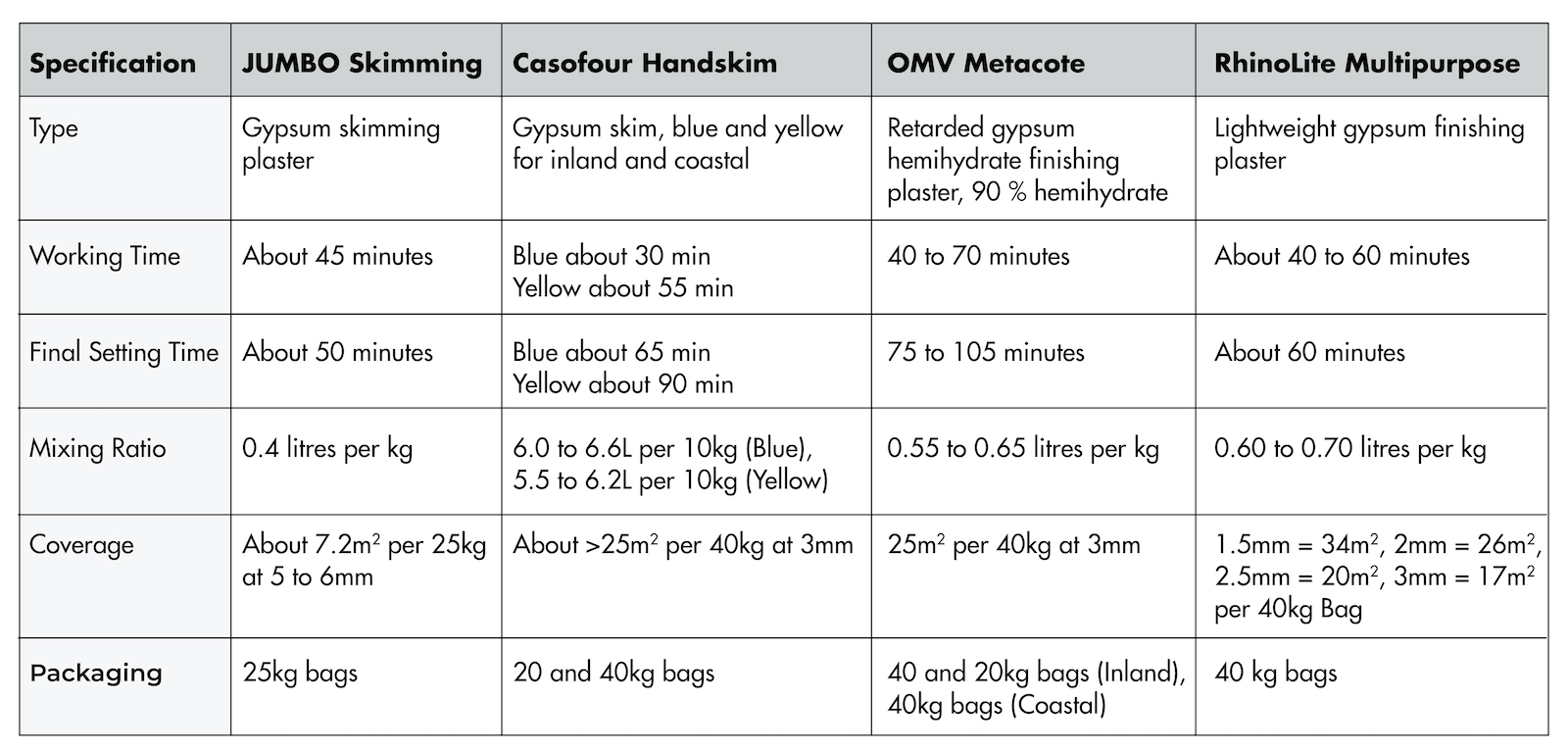 Always check the current product data sheet for exact mixing ratios, coverage and set times before specifying or applying.
Trade tips for a flawless skim finish
- Start clean. Use clean water, a clean container and clean tools free of set material. Residue from a previous batch acts as an accelerator and shortens the working time of the next mix.
- Add powder to water. Sprinkle the powder into clean water, let it soak where the data sheet calls for it, then mix to a smooth, lump free paste. Follow the stated ratio, for example 0.4 litres per kilogram for JUMBO Skimming or 0.55 to 0.65 litres per kilogram for Metacote.
- Match the grade to the climate. Use the inland product such as Casofour Handskim Blue, for dry conditions, and the coastal product for example Handskim Yellow, where higher humidity calls for a longer working window.
- Mind the thickness. Apply Metacote and Casofour Handskim at about 3 millimetres and do not go below the minimum on the bag. Float and polish to bring the fat to the surface for a glass-like finish.
- Control the conditions. Apply within the stated temperature range, between 5 and 40 degrees Celsius for Casofour Handskim, and never below freezing for JUMBO. Allow the full drying time before painting, up to 24 to 48 hours on board for Metacote.
- Store properly. Keep bags off the ground on pallets in a dry, covered area to protect the shelf life and to prevent premature curing from moisture.
Frequently asked questions
What is skimming plaster used for?
Skimming plaster is a thin finishing coat applied over brickwork, concrete, cement plaster, or plasterboard to level out minor imperfections and leave a smooth, uniform surface ready for paint or other decoration. It is the final layer that sets the quality of the wall or ceiling you see.
How long does skim plaster take to dry?
It depends on the product, the thickness, and the conditions on site. Working time runs from about 30 minutes for Casofour Handskim Blue up to about 70 minutes for Metacote. Drying on the board is longer. Metacote, for example, gives a typical drying time of 24 to 48 hours before the surface is ready for paint. Higher humidity and lower temperatures slow drying down, so always allow the full drying time before decorating.
What is the difference between skimming plaster and jointing plaster?
A skimming plaster is a finishing coat spread across a whole wall or ceiling to create a smooth surface. A jointing plaster does a narrower job, bedding the tape and filling the joints between plasterboards so the boards read as one continuous surface. Both are gypsum based and for interior use, but they are formulated for different tasks.
How thick should a skim coat be?
Most skimming plasters are applied at about 3 millimetres. Metacote and Casofour Handskim should not be applied below 3 millimetres. JUMBO Skimming can be built up further, with coverage figures quoted at 5 to 6 millimetres and at 12 to 13 millimetres for thicker levelling work. RhinoLite can be applied from 1.5mm up to 3mm. Always follow the minimum thickness on the bag.
Do you need to sand skimming plaster before painting?
Not always. JUMBO Skimming is formulated to leave a silky-smooth finish that needs no sanding before painting. Casofour Handskim and Metacote are floated and polished while still workable, bringing the fine material known as the fat to the surface for a glass-like finish. Light sanding can still be used to remove any small imperfections once the surface is fully dry.
What is the difference between inland and coastal skimming plaster?
Coastal products are formulated for higher humidity and give a longer working window. Casofour Handskim Blue is the inland product with a working time of about 30 minutes, while Handskim Yellow is the coastal product with a longer working time of about 55 minutes. Metacote is also supplied in Inland and Coastal formulations, with the Coastal product setting over a slightly longer window.
How much skimming plaster do I need?
Coverage depends on the product and the thickness. Casofour Handskim and Metacote both cover about 25 square metres per 40 kilogram bag at 3 millimetres. JUMBO Skimming covers about 7.2 square metres per 25 kilogram bag at 5 to 6 millimetres. Use these as a guide and check the current data sheet, since the substrate and application thickness change the real figure.
The bottom line
JUMBO Skimming, Casofour Handskim, OMV Metacote and RhinoLite Multipurpose all deliver a smooth, professional plaster finish, with differences in working time, setting time and packaging to suit different sites. Choose JUMBO Skimming for a fast, ultra-white one-step skim that needs no sanding. Choose Casofour Handskim where you want a glass-like